documentation // station protocol
Method
Joker Radar exists because "best joker games" listicles are written by people who played each game for eleven minutes, if at all. The station's answer is a protocol: fixed, boring, and applied identically to every game that enters the sweep queue. Boring protocols produce trustworthy signals. That is the whole theory.
The scope filter is strict. A game enters the queue only if it is genuinely free to play and puts a joker, jester or wild-card figure at the centre of its design — as a mechanic, a character, or both. Games with a joker sticker slapped on generic gameplay get swept, identified, and rejected in the log. Nothing on this station involves staking of real value of any kind; if a game tries to blur that line, it is disqualified on sight and noted in the log with a flag.
The station accepts no sponsorships, review copies with strings, or "partnership" arrangements from studios. Every rating is one operator's documented opinion. Documented is the important word — every claim in a report traces back to a dated note in the scan log.
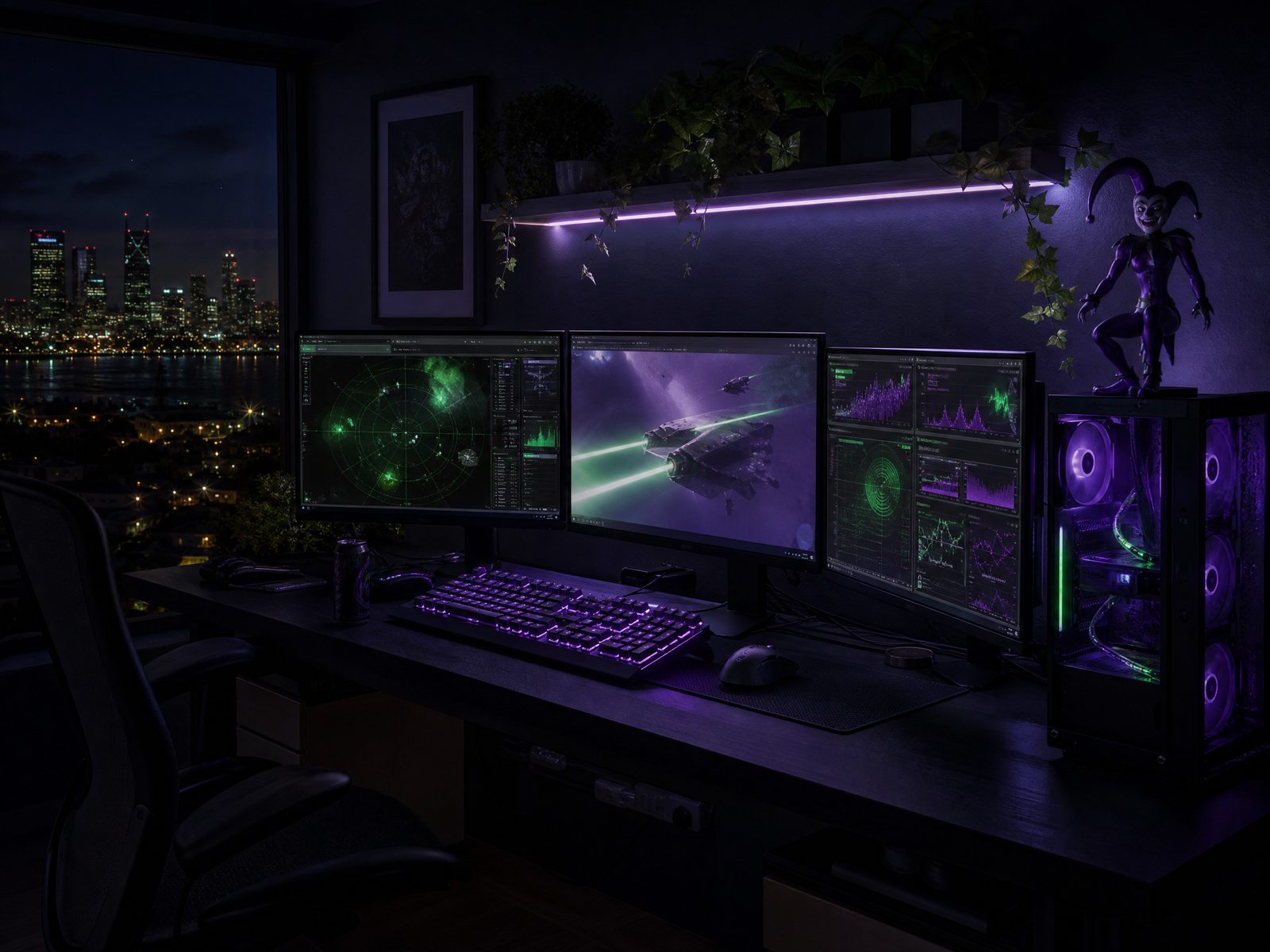
THE ARRAY — the station's entire hardware inventory, plus one supervisory figurine.
// The seven-day scan
The game is played as a new player would play it: no guides, no wikis, tutorial taken at face value. Notes focus on first impressions, onboarding honesty, and how quickly the core loop reveals itself.
The grind window. Sessions at morning, lunch and evening on the same mid-range phone; one longer laptop session nightly. This is where difficulty spikes, repetition and nag-screens surface — the things an eleven-minute reviewer never meets.
Late-game or high-difficulty content, plus the retention test: does the station want to open the game unprompted? Day-seven desire is weighted more heavily than day-one delight.
The report is written from the log, rated, and published. Reports are never edited afterwards; patches and corrections are appended as dated addenda so the paper trail stays intact.
// The signal scale
| Signal | Meaning |
|---|---|
| 5 BARS | Still installed after the scan ended. The station plays it voluntarily. Rare by design. |
| 4 BARS | Held attention all seven days with one or two documented flaws that a patch could fix. |
| 3 BARS | A real recommendation with real caveats. Read the report before committing. |
| 2 BARS | Signal faded by mid-scan. Flashes of quality inside a loop that doesn't hold. |
| 1 BAR | Dead air before day three. Published anyway — negative results are results. |
Games are removed from the board if an update introduces mechanics that break the station's free-to-play scope, if the game is delisted, or if a re-scan drops the rating below two bars. Removals are logged in the frequency report with reasons, because silent deletion is how trackers rot.
// The operator
The station is run by Dee, a systems administrator in Perth who spent a decade keeping other people's servers honest and now applies the same instinct to game recommendations. Dee has been collecting joker and jester games since a childhood copy of a card-game compilation whose wild-card mode was, in retrospect, the only good part.
Why joker games specifically? Because the wildcard is the single most interesting object in casual game design — a rule-breaker that must itself be governed by rules. Watching a hundred designers solve that paradox a hundred ways is the station's real hobby. The games are just the antenna.
Joker Radar operates from a desk at Level 25, 108 St Georges Terrace, Perth — the tallest thing the station could reasonably bolt an aerial to, figuratively speaking. Correspondence lands via the signal page and is read nightly during the log review.
// Scans completed: 19
// Games on board: 5
// Games rejected at intake: 44
// Five-bar ratings ever issued: 3
// Sponsored reports: 0, forever